For years, the “year of the Linux desktop” has been a running joke, and the “Windows on ARM” revolution has been a perpetual promise—always just around the corner, yet never quite arriving. But while Microsoft and Qualcomm have been locked in a clumsy dance to force the square peg of x86 legacy Windows into the round hole of ARM architecture, a far more dangerous contender has been waiting in the wings.
The coming “Android PC” (rumored to be codenamed “Aluminum”) represents a seismic shift in personal computing. For Qualcomm, this isn’t just another product line; it is the escape hatch from the shackles of Microsoft’s legacy debt. But as with all things Google, the hardware is only as good as the company’s famously fickle attention span allows it to be.
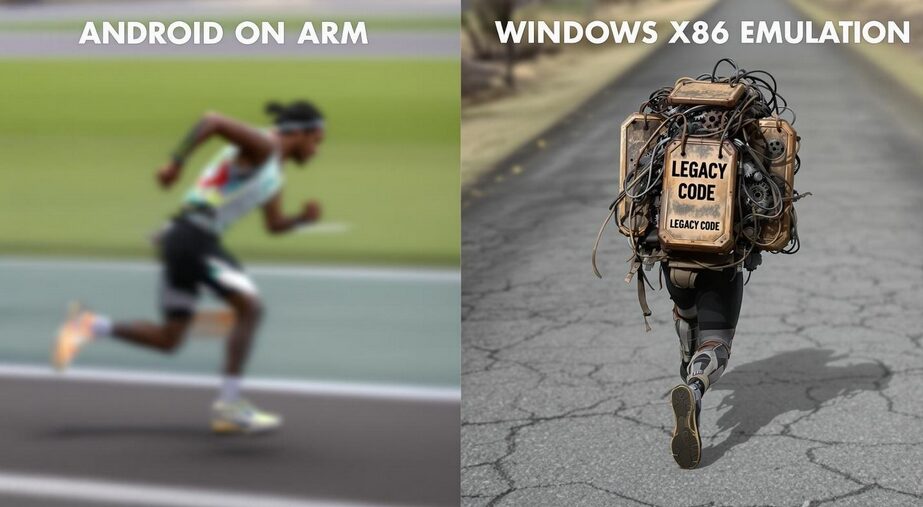
The Native Advantage: Why Android Beats Windows for Qualcomm
The fundamental flaw of the “AI PC” push with Windows on ARM is friction. Despite Microsoft’s heroic engineering efforts with the PRISM emulator, Windows on Snapdragon is still fighting a war against decades of x86 bloat. Every time a user opens a legacy app, the processor has to work harder, draining the very battery life that is supposed to be ARM’s killer feature.
An Android PC flips this script entirely. Android is, and always has been, native to ARM. There is no translation layer, no emulation tax and no legacy BIOS dragging down boot times. For Qualcomm, an Android laptop allows its Snapdragon X Elite chips to run purely as intended—screamingly fast and impossibly efficient. It transforms Qualcomm from a “compatible alternative” into the primary architecture, unleashing performance that Windows simply cannot match due to its architectural overhead.
A Tale of Two Ecosystems: Google’s Developer Renaissance
While Microsoft has spent the last five years confusing its developer base with a revolving door of UI frameworks—from UWP to WinUI 3 to MAUI, leaving a trail of broken documentation and frustrated coders—Google has quietly executed a masterclass in consistency.
Through Jetpack Compose and Kotlin, Google has given developers a modern, declarative toolkit that “just works” across form factors. The developer sentiment is shifting; building for Android feels like the future, while building for Windows feels like archaeology. By unifying the Android ecosystem to span from pocket to desktop, Google is offering developers a single target with billions of active users, contrasting sharply with Microsoft’s fragmented attempt to woo developers back to a Store they largely ignore.
The Ghost of Internet Explorer: Windows’ Marketing Void
There is a haunting parallel between the current state of Windows and the fall of Internet Explorer (IE). In the early 2000s, Microsoft believed its monopoly was a moat that didn’t need maintenance. It stopped marketing IE, stopped innovating and assumed users would never leave. Then came Firefox and Chrome, and the rest is history.
Today, Windows is suffering from the same complacent “lack of marketing.” Microsoft treats Windows as a utility—a default choice rather than a desired product. They have failed to create demand for the OS itself, relying instead on OEM partners to do the heavy lifting. Just as users fled IE because it felt stale and unloved (not because it didn’t work), the consumer market is ripe to abandon Windows for a platform that feels vibrant, mobile-first and modern.

The “Shiny Object” Syndrome: Google’s Achilles’ Heel
However, the path to victory is paved with Google’s discarded projects. The single biggest threat to the Android PC isn’t Apple or Microsoft; it is Google’s own corporate ADHD. The company has a historic inability to sustain “demand generation” marketing. It launches products with a bang (Stadia, Google+, Pixel Slate) and then abandons them the moment the metrics don’t immediately curve upward.
This behavior is epitomized by Google’s handling of Nest and the Matter standard. Nest was the premiere brand in smart homes—the “Apple of the thermostat.” Yet, through a lack of focused marketing and confusing rebrands, Google allowed it to stagnate. Similarly, Matter was poised to unify the smart home, but Google’s failure to aggressively market the benefits to consumers—rather than just the specs to geeks—has left it floundering in obscurity.
If Google treats the Android PC with the same “attention span of a four-year-old on sugar,” shifting focus to the next shiny AI toy six months after launch, this platform will join the Google Graveyard faster than you can say “Google Glass.”

Wrapping Up
The Android PC represents a “perfect storm” of opportunity. For Qualcomm, it is the platform that finally lets the silicon shine without the heavy anchor of Windows legacy. For developers, it is a unified haven compared to Microsoft’s chaotic landscape. But for this to work, Google must do something it has historically hated doing: commit to the grind of long-term, demand-generation marketing. It cannot just build it and hope they come; it must sell it, sustain it and stand by it. Otherwise, the Android PC will be just another fascinating prototype in a museum of missed opportunities.
The post The sleeping giant awakes: Why the Android PC is Qualcomm’s real ticket to the throne appeared first on SD Times.
from SD Times https://ift.tt/5AMn3Wa
Comments
Post a Comment